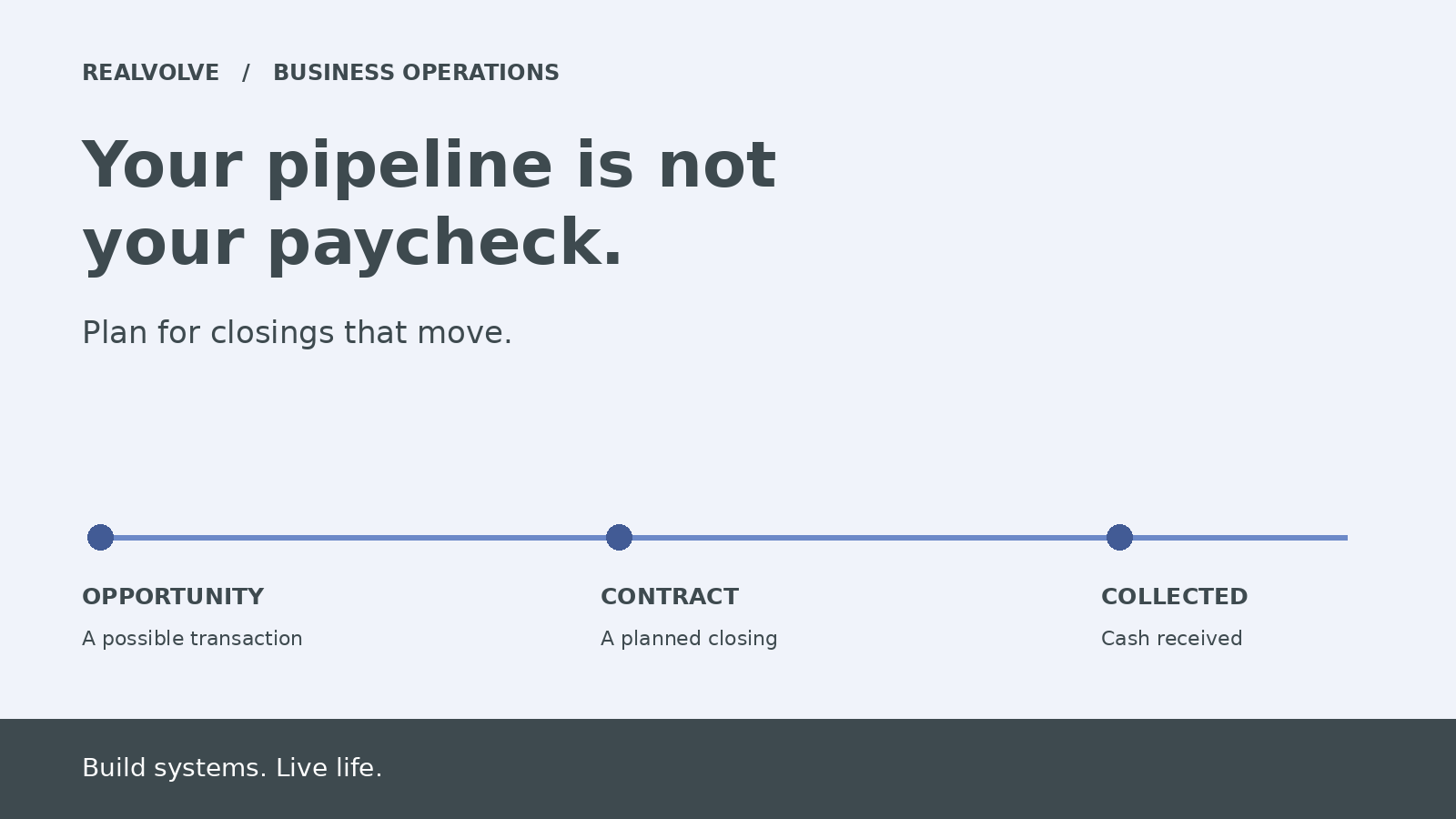
A full pipeline can make an agent feel secure right up until the month the closings move.
The conversations are real. The clients still intend to buy or sell. But intention does not pay next month's operating expenses. When the market slows, the business-owner challenge is to protect the relationships without treating every possible transaction as near-term revenue.
New research gives agents a reason to examine that distinction now. Realtor.com's November 12, 2026 report, covering the week ending November 7, shows new listings down 10.3% from a year earlier while active inventory was up 8.3%. Median time on market was 65 days, just one day longer than a year earlier. This is not evidence that every transaction is suddenly taking dramatically longer. It is evidence of a market in which more inventory does not necessarily mean more willing participants.
In a separate November 11 analysis, Realtor.com estimated that moving to a median-priced home would raise the typical existing mortgage holder's principal-and-interest payment by 85.3%. That comparison used September home-price and down-payment assumptions and an October 22 mortgage rate of 7.32%; it is not a current rate quote or an individual borrower's estimate. Taxes, insurance and other ownership costs are outside that payment comparison.
The practical response is not to predict when everyone will move. It is to build a business that can distinguish opportunity from timing.
1. Separate relationship potential from revenue evidence
A homeowner who would like to move someday belongs in your relationship system. They do not automatically belong in next month's income forecast.
Give each opportunity an evidence-based stage. For example: exploring, preparing, actively searching or marketing, under contract, and closed. Define what must be true before a record advances. A friendly conversation alone should not turn an exploring homeowner into a likely December closing.
For each active opportunity, record the next decision, the person responsible, the expected date and what could prevent progress. The useful question is: What has changed that makes this transaction more likely to happen within this period?
Do not assign universal conversion percentages to those stages. Build estimates from your own comparable past transactions, and treat small samples cautiously. A signed contract provides more evidence than an informal plan, but it still is not collected income.
2. Give delayed clients a different service rhythm
Some clients need immediate action. Others need time, a lender conversation, a job decision or a clearer view of their options. Giving both groups the same intensive cadence can consume the capacity you need to serve either well.
For a client who is waiting, agree on a useful next checkpoint and the event that would justify an earlier conversation. That might be a change in their timeline, a completed financing review or a property that meets their stated requirements. Record their communication preferences. Avoid turning a personal constraint into a generic stream of sales messages.
This is a natural role for a CRM and workflows: keeping the context, responsibilities and next steps connected. Realvolve supports tasks and communications organized around a repeatable process. The judgment about what the client actually needs remains yours.
3. Test the calendar, not just the annual total
Build a simple 13-week view of expected cash receipts and planned payments. Keep collected cash separate from possible receipts. Include operating expenses, planned owner pay, taxes set aside with your adviser and other obligations that affect available cash.
Then run a timing scenario. Move a few expected closings into a later period while leaving their amounts unchanged. The business can have the same eventual revenue and still face a very different month.
Illustrative example, not a benchmark: Suppose three closings are expected to contribute $6,000 each after brokerage splits, referral fees and direct transaction costs. That is $18,000 before business overhead, taxes and owner compensation. If two closings move beyond the next four weeks, the expected contribution arriving in that window falls to $6,000. Against $9,000 of planned cash outflows, that leaves a $3,000 gap before opening cash reserves or other receipts.
The lesson is not that every agent needs the same reserve. It is that a timing test reveals decisions early: which optional commitments can wait, which costs are essential, and when to review the plan with your bookkeeper or accountant. Do not fund a new recurring expense solely because the pipeline looks busy.
4. Protect capacity for the work that moves decisions forward
More activity is useful only when it serves a purpose. Review where your week goes: active-client work, relationship development, administration and avoidable rework.
Choose one repeated administrative handoff to improve. Give it a clear owner, a due date and a definition of done. Track whether the change reduces missed steps or releases usable time. Automation that creates more checking and corrections has not yet solved the problem.
Preserve room for new business without neglecting people whose timeline has lengthened. The aim is a service model you can sustain, not a calendar filled with touches that nobody values.
5. Review the exceptions every week
Keep the weekly review short: What advanced? What slipped? What needs a decision? Which expected receipt changed weeks? Which relationship has no agreed next step?
Use local evidence and your own pipeline rather than applying national figures mechanically. Some markets and client situations will move faster than others. A strong week is useful information, but one good week does not establish a new conversion rate.
The Realvolve 2027 Business Planner can help connect your broader goals to weekly action. Pair that planning with an honest view of timing. Growth needs opportunity; control requires knowing which parts of the plan are supported by evidence.
A durable business can keep investing in relationships while acknowledging that some revenue will arrive later. Build systems that make that distinction visible, and you can make decisions with more room to think.
Book a Realvolve walkthrough to explore how contacts, follow-up and transaction workflows can support the way you operate.
Build systems. Live life.
Sources
- Realtor.com Economic Research, Hannah Jones, November 12, 2026: Weekly Housing Trends, week ending November 7, 2026.
- Realtor.com Economic Research, Hannah Jones, November 11, 2026: High Housing Costs Keep Homeowners Locked-In.